Down syndrome in mice
Eight classes of mice from 77 protein expression levels. All baselines do well here; the logic replicant still has the best accuracy and cuts the MLP's error by 40%.
Eight groups of mice from 77 proteins. All methods do well; the logic replicant makes about 40% fewer mistakes than the best rival.
What happened
Here the task is to tell eight groups of mice apart from the levels of 77 proteins: with or without a Down-syndrome-like condition, given a drug or a placebo, under two learning protocols. Living systems are noisy, and mice that are alike tend to be in the same group, so every method did reasonably. The small neural network was the best rival at 98.9%. The logic replicant reached 99.3%, which sounds close but means it made about 40% fewer mistakes.
The groups, drawn
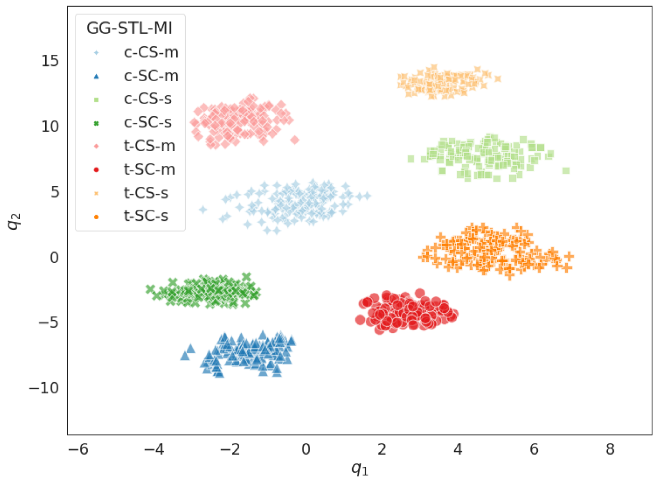
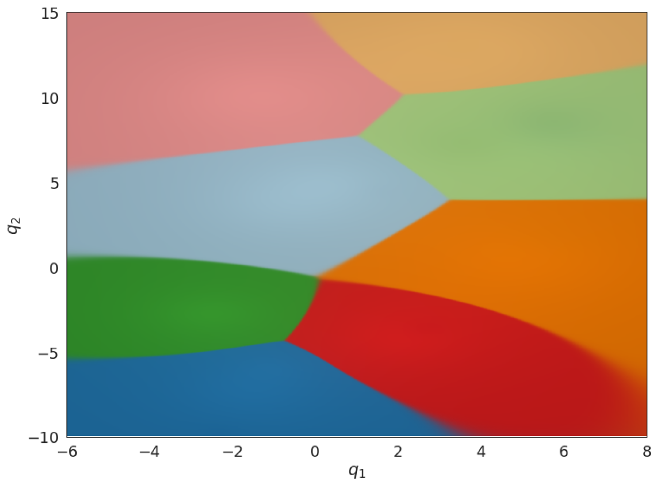
Numbers
| Model | Accur. (train) | Accur. (test) | Precis. (test) | Recall (test) | Configuration |
|---|---|---|---|---|---|
| Replicant | 99.99% | 99.34% | 99.38% | 99.40% | \(S=0, R=0, D=5, |V|=40\) |
| RF | 100.00% | 94.31% | 95.54% | 94.56% | 100 estim., all features |
| MLP | 99.70% | 98.89% | 98.89% | 98.90% | 7 neurons, 1 hidden layer |
| SOM | 92.30% | 87.04% | 87.79% | 87.07% | 3600 neurons (60×60) |
| XGBoost | 99.98% | 93.29% | 93.50% | 93.50% | 100 estim., max depth 7 |
Analysis
This problem depends on organic components and living creatures, so it is not expected to follow a rigid logic without outliers, a context where the baselines deliver their best. Similar inputs generally have similar results, which the random forest exploits in its internal segmentation with up to 77 explanatory variables: 100% in training, 94.31% in test. The MLP is second with 98.89%, using only 15 neurons in total, since a small change in the inputs does not usually change the class and enough cases are available to extrapolate. The SOM, with 3600 neurons, has the lowest accuracies in both phases despite the largest number of parameters. XGBoost behaves like the RF (99.98% / 93.29%) and shows the largest drop from training to test, 6.69 points, against 5.69 for the RF, 5.70 for the SOM and 0.81 for the MLP: the tree-based models learn the training subset better but extrapolate worse than the two neural approaches.
The logic replicant obtains the best test accuracy, 99.34%, with a drop of only 0.64 points from its own training, the best two figures of all models. Because the MLP is already very accurate, it is clearer to compare errors: 1.11% for the MLP against 0.66% for the replicant, a 40.54% reduction. The replicant can take advantage of the problem's logic even where outliers exist, and it can also exploit the similarity of instances when that is the simplest available logic, or combine several compatible logics in the projection to \(Q\).
The logic, made visible
This configuration is sufficient to reduce several groups to one large group per class; with smaller \(S\) and \(R\) the distribution would not be class-isolated and some classes would need several groups. The problem is defined by a main logic that splits the classes, without the symmetric shape seen for parity. Main groups per class are visible in (a), less symmetric and relatively compact, with some exceptions outside them. Comparing with the vortices in (b), most instances within a group match an area covered by a vortex of the corresponding class, while exceptions far from their class's vortices are misclassified. Training tries to place the vortices as close as possible to the instances; their distribution shows that a clear logic exists but exhibits irregular patterns per class, without specific symmetries.