Equivalence with Voronoi tessellations
Lemma 1: with one vortex per class in two dimensions, the classification rule is a Voronoi tessellation under a vortex-defined distance.
In plain words
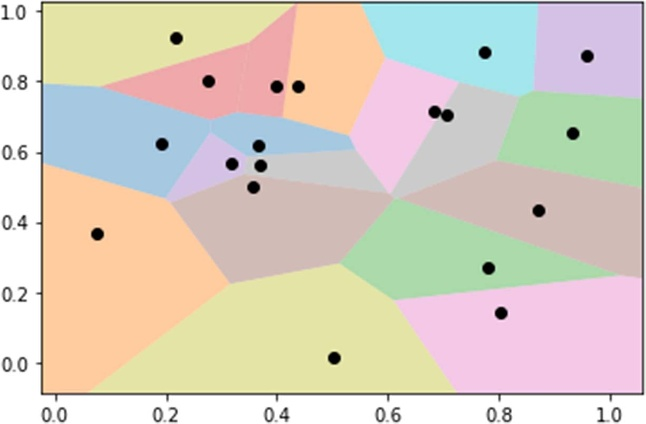
Picture a map with one seed per class. Give every location to the seed that is "nearest", and you get a mosaic of cells, one per seed: a Voronoi diagram, familiar from maps of the closest post office or the pattern on a giraffe's coat.
The lemma says that a two-dimensional logic replicant with exactly one vortex per class produces exactly such a mosaic, where "near" is measured with each vortex's own yardstick: a bigger or stronger vortex reaches further. With several vortices per class the picture is similar but the cells can merge, so the analogy becomes intuitive rather than exact.
Lemma 1
For configurations where \(D=\dim(Q)=2\) and the total number of vortices is equal to the number of classes, \(|V|=|C|\) so \(K=1\), the class selection using the greatest scalar field (17) is analogous to a 2-dimensional Voronoi tessellation where the distance metric corresponds to the inverse of the vortex's scalar field \(U_c(\boldsymbol{q})^{-1}\) (15), where \(d\) is defined as
Argument
The lemma identifies every vortex centre in \(Q\) with the location of a seed in the equivalent Voronoi diagram. The area covered by the \(i\)-th vortex mapping the classification to class \(c\) requires its scalar field (15) to be the greatest within that area among all the others. As there is only one vortex per class, the field of class \(c\) reduces from (16) to \(U_c(\boldsymbol{q})=\Phi_c/\big(1+\rho_c^2(\boldsymbol{q}-\boldsymbol{v}_c)^2\big)\). The greatest scalar field corresponds to the smallest inverse \(U_c(\boldsymbol{q})^{-1}\) (18), so this inverse can be used as the distance metric of the tessellation. In the vortex–Voronoi equivalence, the areas where the \(c\)-th vortex is greatest are the Voronoi cells, where the distance is smallest. The equivalence between the greatest scalar field and the smallest distance \(d=U_c(\boldsymbol{q})^{-1}\) holds for every possible point \(\boldsymbol{q}\in Q\), so both representations are equivalent.
Beyond \(K=1\), the analogy is intuitive rather than exact: vortices tessellate using functions more sophisticated than Euclidean distance, and several vortices of the same class can combine to enhance their class. The empirical nucleosynthesis replicant plotted with one vortex per class is a direct illustration of the lemma.