Vortices
Figurative whirlpools placed in the transformed space, each claiming a region for its class.
What a vortex is
Once the examples sit on the new map, something has to decide which area belongs to which class. That is the job of the vortices. Picture a whirlpool: strongest at its centre, weaker further out. Each vortex belongs to one class and has three learned settings: where its centre is, how quickly it weakens with distance, and how strong it is overall. An example is classified by the vortex, or team of vortices, that pulls hardest where it landed.
Once the instances are projected to \(Q\), something has to decide which area belongs to which class. That is the role of the vortices. Each vortex is a scalar field defined over the whole space \(Q\) and assigned to exactly one class \(c\). It has three parameters: a centre \(\boldsymbol{v}\), which says where it sits; a density \(\rho\), which controls how quickly its field decays with distance; and an intensity \(\Phi\), which scales it:
Every class has the same number \(K\) of vortices and its field is the sum of theirs. A quon \(\boldsymbol{q}\) is classified as the class whose field is greatest there. In the picture the vortices expand from their centres, each trying to cover the greatest possible area before finding the limit set by another vortex.
The Voronoi analogy
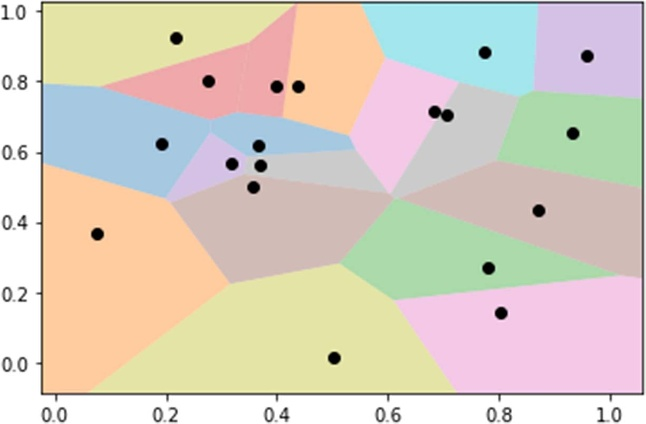
Give each class exactly one vortex and draw the map in two dimensions, and the territories become a mosaic in which every spot belongs to its nearest seed, where "near" is measured with each vortex's own yardstick. That is a Voronoi diagram, the pattern you get when you colour a map by the closest post office. With several vortices per class the cells can merge, so the analogy becomes a picture rather than an exact rule.
With one vortex per class and \(D=2\), the regions where each vortex dominates are exactly the cells of a Voronoi diagram whose seeds are the vortex centres and whose distance is the inverse of the field. The analogy is not perfect in general: the field is a richer metric than Euclidean distance, and several vortices of the same class can combine into a single region. Lemma 1 states the equivalence precisely.
How many vortices
As a rule of thumb, each vortex creates one island, and nearby vortices of the same class can merge into a larger one. Fewer vortices means fewer islands per class, which forces the map-drawing formula to bring each class together, and that is exactly what makes the learned rule compact. Several vortices per class let a class split into distinct sub-groups, like the two ways people write the digit 1. Too many vortices would let the territories themselves do the work and defeat the purpose, so the advice is to keep them few and let the formula carry the complexity.
A reasonable, though not perfect, rule of thumb is that each vortex generates one isolated area, sometimes more, and that several nearby vortices can merge into one area. The fewer vortices, the fewer distinct areas a class can occupy, and the more the transformation is forced to bring that class's instances together. This is the mechanism that makes the learned logic compact. Several vortices per class allow a class to be split into logically distinct sub-groups, as happens with digit 1 in the handwritten-digits experiment. Too many vortices, on the other hand, would let the scalar field itself approximate arbitrary functions of \(D\) variables, defeating the purpose; the advice is to keep vortices few and give the transformation as many parameters as it needs. Low-entropy isolations.