Nucleosynthesis
Seventeen isotope classes from 23 known nuclear reactions. The baselines score between 6.67% and 10.20% in test; the logic replicant scores 72.87%.
Which nucleus comes out of a reaction that powers stars. Rivals score about 10%; the logic replicant scores 72.9%.
What happened
Inside stars, carbon, nitrogen and oxygen nuclei absorb protons and decay in cycles. Given the ingredients of one step, which nucleus comes out? Only 23 real reactions are known, and there are 17 possible answers. The rival methods scored between 7% and 10%, close to guessing, because two reactions with almost the same ingredients can have completely different products. The logic replicant scored 72.9%, because the laws of physics behind the reactions form a strict rule with no exceptions, exactly what it is built to find.
The isotopes, drawn
Numbers
| Model | Accur. (train) | Accur. (test) | Precis. (test) | Recall (test) | Configuration |
|---|---|---|---|---|---|
| Replicant | 99.99% | 72.87% | 73.56% | 72.72% | \(S=0, R=0, D=1, |V|=17\) |
| RF | 99.17% | 8.33% | 12.50% | 7.25% | 100 estim., all features |
| MLP | 100.00% | 10.20% | 10.48% | 11.05% | 5 neurons, 1 hidden layer |
| SOM | 100.00% | 8.33% | 9.65% | 8.75% | 121 neurons (11×11) |
| XGBoost | 17.08% | 6.67% | 8.61% | 6.46% | 100 estim., max depth 7 |
Analysis
This experiment shows the replicant's capacity to generalise with a large number of classes (17) relative to the number of instances (23 original, 204 augmented) when the underlying logic is well defined. It is challenging for every model. XGBoost performs worst, 17.08% in training and 6.67% in test; its general configuration seems not to suit a problem with only a few samples per class, or it is an intrinsic limitation, since the same configuration did better elsewhere. The RF and the SOM both reach 8.33% in test despite 99.17% and 100% in training: the similarity of features cannot be used to assume that resembling instances share a class, and it penalises the models that rely on it, because small changes in the reactants lead to a completely different product. The MLP reaches 10.20%.
The logic replicant obtains 72.87%, with 99.99% in training and a gap of 27.12 points. Finding a common logic is the most suitable strategy here, because the problem results from the fundamental forces operating on the particles that constitute the nuclei, and these forces accept no exception: the inherent logic is compact and can be generalised.
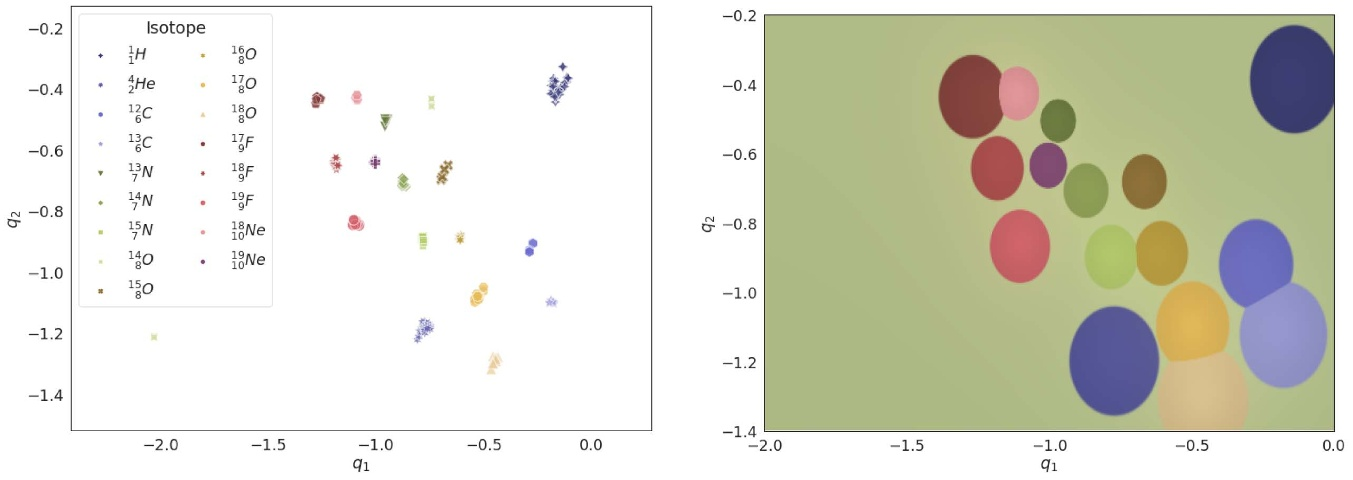
The logic, made visible
The colours and shapes represent the isotopes involved in the CNO and HCNO cycles. The model groups the elements of each isotope in dense areas, except for \({}^{14}_{8}\mathrm{O}\) and \({}^{17}_{9}\mathrm{F}\). The vortices in (b), one per class, are in one-to-one correspondence with the isotope classes and cover the groups generated by the leietanic function. With one vortex per class in two dimensions, this plot is a direct instance of the Voronoi equivalence. The reactions themselves are listed on the appendix page.